IEP Goals for Autism: What Good Ones Look Like (With Examples)
If you have ever sat at an IEP meeting holding a thick packet of paper and quietly wondered whether the goals inside it would actually help your child, you are not alone. Writing strong IEP goals for autism is one of the most important parts of the whole process, and yet it is the part families understand the least. The goals are where the plan stops being a folder of paperwork and becomes a roadmap for the year ahead. When they are written well, they tell you exactly what your child is working toward, how the team will know progress is happening, and when you should expect to see it. When they are written poorly, they leave everyone guessing, and the year can slip by without anyone noticing your child is stuck.
This guide is here to walk through what good autism IEP goals look like in plain, friendly language. We will not throw legal jargon at you, and nothing here is legal advice. Instead, think of this as a knowledgeable friend sitting beside you, pointing out what to look for, what to gently push back on, and how to tell a meaningful goal from one that just fills space on the page. We will look at lots of real, side-by-side examples, because seeing a weak goal next to a strong one is the fastest way to train your eye.
What Makes IEP Goals for Autism Actually Meaningful
A meaningful goal does one simple thing: it describes a real, observable change in what your child can do, in a way that everyone on the team can picture and measure the same way. If you read a goal out loud and three different people imagine three different things, the goal is too vague. If you read it and you can already picture exactly what your child will be doing, where, with what help, and how often, you are looking at a strong goal.
The most widely used framework for writing strong goals is the SMART model. SMART goals are Specific, Measurable, Achievable, Relevant, and Time-bound. Specific means the goal targets a clear skill, not a fuzzy idea. Measurable means there is a number or a clearly observable outcome you can count. Achievable means it is a realistic stretch from where your child is today, not a leap that sets them up to fail. Relevant means it matters for your child's actual life, classroom, and future. Time-bound means there is a deadline, usually the end of the IEP year, with checkpoints along the way.
Here is the SMART idea in everyday terms. A weak goal says, "Student will improve communication skills." That sounds nice, but you cannot measure "improve," you cannot see "communication skills" without more detail, and there is no timeline. A SMART version says, "By the next annual review, when shown a preferred item that is out of reach, the student will request it using a 2-word phrase or AAC device in 8 out of 10 opportunities across 3 consecutive sessions, as measured by data collected by the speech-language pathologist." Notice how the second version is something you could actually watch happen and count.
Why Baselines and Present Levels Come First
You cannot write a good goal until you know where your child is starting from. That starting point is called the baseline, and it lives inside a section of the IEP called the Present Levels of Academic Achievement and Functional Performance, usually shortened to PLAAFP. The PLAAFP is the snapshot of your child today: what they can do, what is hard, and how their autism affects their access to learning and daily routines. Every goal in the IEP should grow directly out of this section.
Baselines matter because a goal without one is impossible to measure honestly. If a goal says your child will "initiate peer interactions 4 times per recess" but nobody wrote down how often they do it now, how will anyone know if the goal is ambitious, easy, or already met? A real baseline reads like this: "Currently, during a 20-minute recess, the student initiates an interaction with a peer an average of 1 time, based on observation data collected over two weeks." Now the goal of 4 times means something. You can see the distance to travel.
When you review a draft IEP, read the PLAAFP and the goals side by side. Each goal should clearly connect to a need described in the present levels. If a goal appears that has nothing to do with anything in the PLAAFP, that is worth a question. And if the present levels describe a real struggle but no goal addresses it, that gap is worth raising too. The present levels and the goals are supposed to be two halves of the same conversation.
The Common Goal Domains for Autism
IEP goals for students with autism usually fall into a handful of recognizable areas, often called domains. Not every child needs goals in every domain, and the mix should reflect your child specifically. But knowing the typical categories helps you spot whether the team has thought about the whole child or only the parts that show up in the classroom. The most common domains include:
Example Goals Across Every Domain
This is the part most parents come looking for, so let us get concrete. The examples below are models you can use to calibrate your eye, not templates to copy word for word, because every goal must be built from your own child's baseline. For communication, a strong goal might read: "By the annual review, during structured and unstructured activities, the student will respond to a peer's or adult's comment by adding a related comment of their own in 7 out of 10 opportunities across 3 sessions, as measured by speech-language pathologist data."
For social skills: "Given a small-group activity and a visual cue, the student will take a turn and wait for others to take theirs without leaving the activity in 4 out of 5 opportunities across 3 consecutive weeks." For self-regulation: "When the student notices rising frustration, they will independently use a taught calming strategy, such as requesting a break or using deep breathing, before a behavior escalation occurs, in 80 percent of observed instances across a grading period."
For academics: "After reading a grade-level adapted passage, the student will answer 4 out of 5 literal comprehension questions correctly across 3 consecutive assignments." For daily living and adaptive skills: "During the lunch routine, the student will independently open 3 of 4 food containers and clean their space when finished in 4 out of 5 school days over a month." For behavior: "When given a non-preferred task, the student will request help or a brief break using words or an AAC device, rather than leaving the area, in 8 out of 10 opportunities across 3 weeks." Each of these names the situation, the behavior, the criterion, and the way it is measured, which is exactly what you want to see.
Red Flags and Weak Goals to Push Back On
Once you know what strong looks like, weak goals start jumping off the page. The most common red flag is vagueness, where words like "improve," "increase," "better," or "appropriate" appear with no number attached. "Appropriate" is an especially slippery word in an autism IEP, because appropriate to one person can mean something very different to another. If a goal uses it, ask what specific, observable behavior counts as appropriate, and ask for that definition to be written into the goal itself.
Another red flag is goals that measure compliance rather than skill. A goal like "Student will follow adult directions 90 percent of the time" tells you a lot about what is convenient for adults and very little about what your child is learning. Watch too for goals that are really just descriptions of a service, such as "Student will attend speech therapy twice a week." Attending a session is not a goal; it is a service. The goal is the skill the session is meant to build.
Finally, be cautious of goals copied from last year with the date changed, goals with no baseline, and goals so easy they will be met in a month or so hard they cannot realistically be reached in a year. A goal that was not met last year does not automatically belong in this year's plan unchanged; the team should ask why it was not met and adjust the approach, the supports, or the goal itself. You are allowed to ask, "How was this goal chosen, and what changed from last year?"
Weak vs. Strong: Side-by-Side Rewrites
Seeing the rewrite happen is the best teacher, so here are several. Weak: "Student will improve social skills." Strong: "During recess, the student will join an ongoing peer activity by asking to play or taking an open role in 3 out of 5 opportunities per week across one month, as measured by staff observation." The weak version is a hope; the strong version is a plan you can watch unfold.
Weak: "Student will behave appropriately in class." Strong: "When transitioning between activities, the student will follow the transition routine using a visual schedule with no more than one prompt in 4 out of 5 transitions per day across two weeks." Weak: "Student will increase reading." Strong: "Given a passage at instructional level, the student will read aloud at 90 words per minute with 95 percent accuracy across 3 consecutive sessions, as measured by curriculum-based assessment."
Weak: "Student will communicate wants and needs." Strong: "Across the school day, the student will independently initiate a request for a desired item, activity, or break using their AAC device in 10 or more instances per day across 5 consecutive days." Weak: "Student will manage emotions." Strong: "When the student becomes upset, they will identify their feeling using a feelings chart and choose one calming strategy from their toolkit in 4 out of 5 observed instances across a grading period." In every pair, the strong goal answers four questions: under what conditions, doing what behavior, to what measurable standard, measured how.
How Goals Connect to Services and Progress Monitoring
Goals do not float on their own. Each one should be supported by the services, accommodations, and specialized instruction listed elsewhere in the IEP. If your child has a communication goal, there should be speech-language support or instruction designed to teach that skill. If there is a self-regulation goal, someone should be teaching and practicing those strategies, not just expecting them to appear. When you read the IEP, trace each goal to the support that will drive it. A goal with no service or instruction behind it is a goal nobody is responsible for.
Progress monitoring is how the team checks whether a goal is on track during the year, not just at the end. The IEP should state how often you will receive progress reports, often each grading period, and how progress will be measured for each goal, such as data sheets, work samples, or structured observations. Good progress reporting tells you more than "making progress" or "satisfactory." It gives you the actual numbers: the student is now requesting items 6 times per day, up from a baseline of 1, on track to meet the goal of 10.
If progress reports keep saying "making progress" with no data, you can ask to see the underlying data. You have every right to understand how the team knows your child is improving. And if the data shows a goal is flat for a marking period or two, that is not a reason to wait until the annual review. It is a reason to reconvene and adjust the instruction, the supports, or the goal. Progress monitoring exists precisely so problems get caught early, while there is still time to change course.
Your Right to Disagree Before You Sign
Here is something many parents do not realize until later: you are a full member of the IEP team, and the goals are not final just because they appear in a draft. If a goal is vague, missing a baseline, irrelevant to your child's real needs, or simply not something you agree with, you can say so at the meeting and ask for it to be rewritten. You can request that specific, measurable language be added. You can ask for a goal in a domain the draft skipped. None of this makes you difficult; it makes you an engaged partner, which is exactly the role the process is built around.
You also do not have to sign in the moment if you are unsure. It is perfectly reasonable to ask for a copy of the draft to review at home, to take time to read each goal carefully, and to come back with questions or proposed changes. Bring notes. Ask the team to walk through any goal you do not understand, and to explain how each one connects to the present levels and to the services. A goal you do not understand is a goal you cannot meaningfully monitor at home, so understanding it is part of your job as a parent on the team.
When you do raise concerns, framing them around measurability and your child's needs tends to land well. Try questions like, "How will we measure this one?" or "What is the baseline here?" or "This goal does not seem to match the struggle described in the present levels; can we talk about that?" These are collaborative, specific, and hard to brush aside, and they keep the focus where it belongs, on writing goals that will genuinely move your child forward.
How to Track Goal Progress Between Meetings
The IEP year is long, and a lot happens between the annual meeting and the next one. The families who feel most in control are the ones who keep their own light record of how things are going, rather than waiting passively for the school's progress reports. You do not need to become a data scientist. You just need a simple, steady way to notice patterns, so that when something is working or not working, you have more than a vague feeling to bring to the table.
A practical approach is to write down each goal in plain language, note the baseline the school gave you, and jot quick observations as you see them at home or hear about them. If a communication goal is in place, you might note the week your child started requesting items on their own at dinner. If a self-regulation goal is active, you might note that the calming strategy worked twice this week but fell apart during a hard transition. These small notes turn into a real story over a few months, and that story is powerful at the next meeting, especially when it lines up with or challenges the school's data.
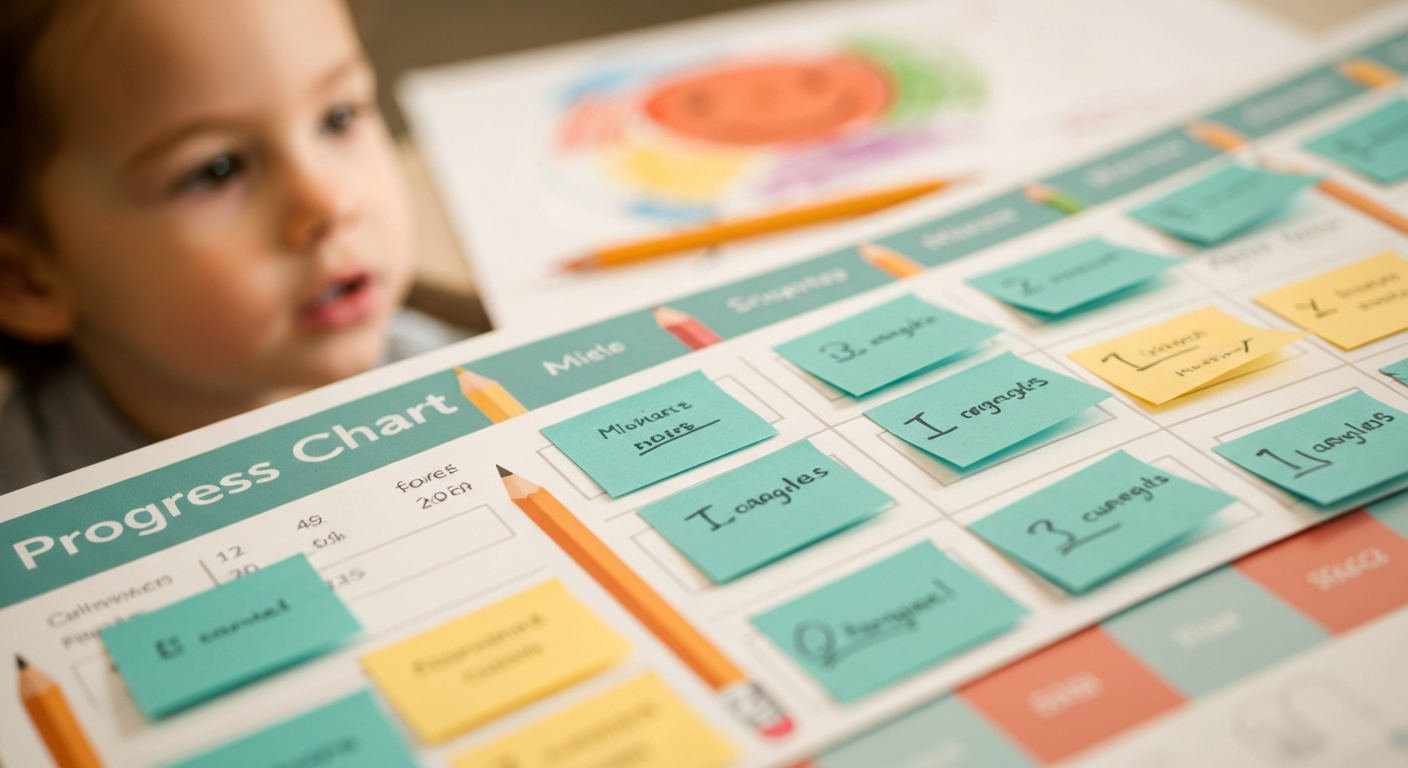
Keeping every goal, baseline, progress report, and your own observations together in one place is what makes all of this manageable instead of overwhelming. When the goals, the numbers, and your notes live side by side over time, you can see at a glance whether your child is climbing toward each goal or stalling, and you walk into every meeting prepared rather than reacting. That is the quiet superpower behind a strong IEP: not just writing good goals once, but watching them, together, all year long.
Keep it all in one place
Advocate Binder helps you organize documents, track goals, prep for meetings, and manage insurance — calmly, in one app.
Start your free trial