IEP Accommodations for Autism: A Parent's Complete Guide
If you are sitting at a kitchen table the night before an IEP meeting, highlighter in hand, trying to make sense of a stack of paperwork, take a breath. You are exactly the parent your child needs, and you do not have to become a lawyer or a special-education expert overnight to advocate well. This guide to IEP accommodations for autism is here to walk beside you in plain language, explaining what accommodations actually are, the wide range that schools can put in place, and how to make sure the supports your child needs are written down clearly and actually happen every single day.
Accommodations can be the difference between a child who is melting down by 9:30 every morning and a child who feels safe enough to learn. They are not extras or favors. They are the practical adjustments that level the playing field so your autistic child can show what they know and grow. Let's slow down and unpack all of it together, one piece at a time.
Accommodations vs. Modifications: The Difference That Matters
This is the single most important distinction to understand before any IEP meeting, because the two words sound similar but mean very different things for your child's education. An accommodation changes HOW your child learns or demonstrates knowledge. It does not change WHAT they are expected to learn. The grade-level standard stays the same; you are simply removing a barrier so your child can reach it. Letting a student type instead of handwrite, giving extra time on a test, or providing noise-canceling headphones are all accommodations. The expectation is identical to every other student's.
A modification, on the other hand, changes WHAT your child is expected to learn or master. It alters the actual content, the grade-level expectation, or the standard itself. For example, if the class is reading a novel and answering analysis questions, a modified assignment might ask your child to read a simplified version and answer fewer or different questions. Reducing the number of spelling words a child is responsible for, or grading against a different standard than peers, are modifications.
Why does this matter so much? Because modifications can carry long-term consequences that are easy to miss in the moment. In many states, a heavily modified curriculum can affect whether a student is on track for a standard high school diploma versus an alternate or certificate-of-completion pathway. That is not a reason to fear modifications, which are genuinely the right call for many children, but it is a reason to ask the team directly, at every meeting, whether any modifications are in place and what they mean for your child's diploma track and long-term options. A good rule of thumb: accommodations open the door wider, modifications change the room your child walks into.
One quick but important note before we go further. This article is informational and meant to help you understand your options and ask better questions. It is not legal advice. Special education law and the way it is applied vary by state and district, and if you find yourself in a serious dispute, a special-education advocate or attorney who knows your state is worth their weight in gold.
Why Every Accommodation Must Be Written Into the IEP
Here is a hard-won truth that experienced parents learn, sometimes the painful way: if it is not written in the IEP, it does not exist. A kind teacher might verbally agree to give your child movement breaks or a quiet corner, and that teacher might be wonderful about it. But teachers change, substitutes fill in, your child moves up a grade, and that informal kindness walks out the door with the person who offered it. An accommodation written into the IEP is a legally binding commitment that follows your child no matter who is in the room.
When an accommodation goes into the document, push for it to be specific. Vague language like 'extra time as needed' or 'breaks when appropriate' leaves everything to interpretation, and interpretation tends to shrink supports over time. Instead, aim for accommodations that answer who, what, where, when, and how often. 'Extended time' becomes 'time and a half on all tests and quizzes, in a separate setting, provided by the special education teacher.' 'Sensory breaks' becomes 'a five-minute movement break every 30 minutes, available in the classroom or the sensory room, initiated by the student showing a break card.'
This level of detail protects your child and protects the staff too, because everyone knows exactly what is expected. It removes the daily guesswork and the awkward negotiations that can leave a child without support on a hard day. When you read the draft IEP, slow down on the accommodations section and gently ask, for each one, 'How will we know this is happening, and who is responsible for it?' If the team cannot answer clearly, the wording probably needs work.
A Categorized List of Common IEP Accommodations for Autism
Below is a broad menu of IEP accommodations for autism, grouped by the kind of barrier each one addresses. No child needs all of these, and the goal is never to load up the IEP with everything on a list. The goal is to match supports to your specific child's profile, strengths, and challenges. Read through these as conversation starters for your next meeting, and notice which ones make you think, 'Yes, that is exactly what my kid needs.'
Sensory accommodations help a child whose nervous system is over- or under-responsive to the sensory world of a classroom:
Processing and instructional accommodations support a child who needs information delivered differently to take it in and act on it:
Transition accommodations help a child who struggles when activities, settings, or expectations change:
Social accommodations support a child navigating the unwritten rules and demands of peer interaction:
Behavior and regulation accommodations help a child manage big feelings and stay available for learning:
Communication accommodations ensure a child can understand and be understood, whatever their communication style:
Environmental accommodations adjust the physical and structural setting to reduce barriers:
Autism Classroom Accommodations in Daily Practice
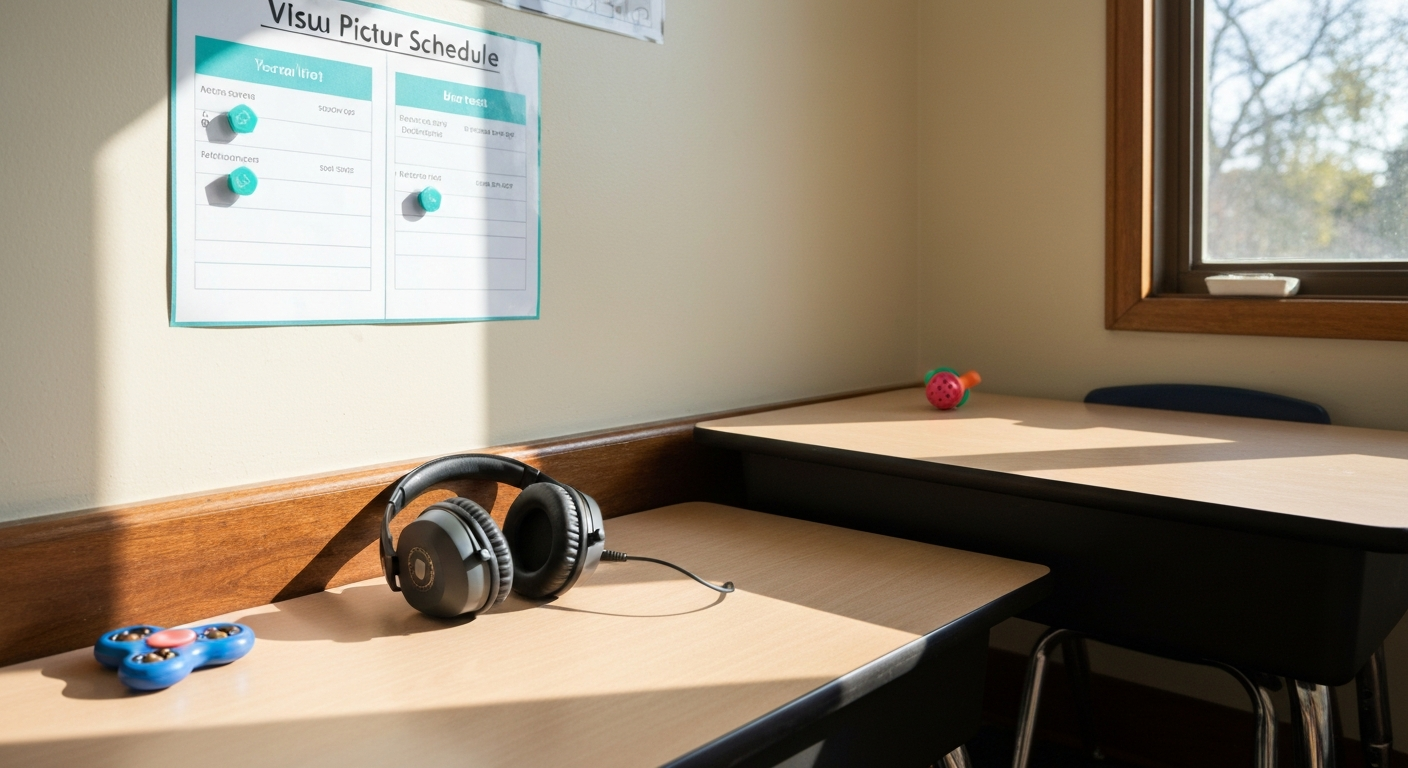
It is one thing to list autism classroom accommodations on paper and another to see them woven into a real school day. The most effective supports are the ones that become invisible because they are simply how the classroom runs. A visual schedule on the wall, a quiet corner with a beanbag, a teacher who hands out guided notes to everyone so no child is singled out, a break card system that any student can use without explanation. When accommodations are built into the rhythm of the room, your child gets to be a student first rather than the kid who needs special treatment.
Universal design is your friend here. Many accommodations for students with autism, like clear visual routines, chunked instructions, and predictable expectations, actually help every learner in the room. When you frame a request to the team, it can help to point out that the support benefits the whole class while being essential for your child. Teachers are far more likely to embrace and consistently deliver an accommodation that makes their entire classroom run more smoothly.
Pay attention, too, to the difference between accommodations that require the child to advocate in the moment and those that are simply provided. A child who must raise their hand and announce to the room that they need a break may never use the support, especially when dysregulated. An accommodation that is offered proactively, or accessed through a discreet signal, is far more likely to actually work. As you review autism school accommodations with the team, keep asking, 'Will my child realistically be able to use this on a hard day, or does it depend on them having skills they are still building?'
Accommodations for Standardized and State Testing
State assessments and other standardized tests deserve their own conversation, because the rules around them are stricter and the stakes can feel higher. The accommodations a child uses every day in the classroom should generally carry over to testing, but not automatically. Testing accommodations must be specifically listed in the IEP, and they have to fall within the approved list of allowable accommodations that your state's testing program publishes. Some everyday supports are allowed on state tests; others are not, and using a non-allowed accommodation can invalidate a score.
Common testing accommodations that are frequently approved include:
The most important principle for testing is consistency: a child should use the same accommodations during instruction and practice that they will use on test day. A support that appears for the first time during a high-stakes test is unfamiliar and unhelpful, and many states actually require that an accommodation be used routinely before it can be applied to the assessment. Ask the team to confirm that every testing accommodation in the IEP is both on your state's approved list and being used regularly in the classroom, well before testing season arrives.
When Accommodations Aren't Being Implemented
Few things are more frustrating than negotiating a thoughtful set of accommodations and then discovering they are not actually happening. Maybe your child mentions they never get their breaks, or you notice handwritten assignments coming home when the IEP says they can type, or a new teacher seems unaware of the document entirely. This happens, and it does not mean you failed. It means it is time to act calmly and in writing.
Start by documenting what you are observing with dates and specifics, then put your concern in writing to the case manager or teacher rather than relying on a hallway conversation. A short, friendly email creates a record and often resolves the issue quickly, because most lapses come from a busy staff member who simply did not have the accommodations top of mind. Something like, 'I noticed Jamie's assignments are being handwritten, and the IEP calls for typing on written work. Can we make sure that support is in place? Thank you for everything you do for him,' is firm and kind at once.
If the pattern continues, you can request a meeting to address implementation, and you have the right to call an IEP meeting whenever you have a concern, not just at the annual review. When accommodations written into an IEP are consistently not being delivered, that can rise to a failure to provide the services the document promises, which is a serious matter. This is precisely where your written records become invaluable, and where consulting a special-education advocate or attorney in your state may be warranted. The throughline is always the same: keep it in writing, keep it specific, and keep your tone collaborative for as long as the situation allows.
When Accommodations Alone Aren't Enough
Here is something that gets lost in many accommodation-focused conversations: accommodations are not the whole picture, and they were never meant to be. An accommodation removes a barrier so a child can access instruction, but it does not teach a new skill. If your child needs to learn to read, to communicate, to regulate emotions, or to navigate social situations, those skills require actual specialized instruction and related services, not just supports that make the existing environment more bearable.
This distinction matters legally and practically. A school is required to provide a free appropriate public education, often abbreviated FAPE, and that means an education reasonably calculated to enable real progress in light of your child's circumstances. A pile of accommodations cannot substitute for the specially designed instruction, speech therapy, occupational therapy, social skills instruction, or behavioral support that a child actually needs to make progress. If the team's answer to every concern is to add another accommodation rather than to provide direct instruction or a service, that is a signal to ask harder questions.
When you review the IEP, look at the goals and the services section, not just the accommodations list. Ask whether your child is receiving instruction designed to build the underlying skills, and whether the data shows genuine progress on those goals. If a child has been carrying the same goals year after year with little movement, accommodations are likely papering over a need for more intensive, specialized teaching. Accommodations and specialized instruction work hand in hand: the supports keep your child in the game, and the instruction helps them grow.
Reviewing and Updating Accommodations Every Year
Your child is not the same person they were twelve months ago, and their accommodations should not be frozen in place either. At minimum, the IEP team reviews the plan once a year at the annual meeting, but the accommodations section deserves genuine attention at every one of those meetings rather than a quick copy-and-paste from last year's document. Some supports your child has outgrown; others have become essential; new challenges have appeared with a new grade, new building, or new social landscape.
Before each annual review, it helps to do your own informal audit. Which accommodations does your child actually use, and which sit unused on the page? Which ones make the biggest difference at home and in the community? Have any become a crutch that is holding back a skill your child is now ready to build? Are there new barriers, like a louder classroom, a heavier homework load, or a harder social environment, that call for supports that were not needed before? Bring these observations to the meeting, ideally in writing, so the conversation is grounded in your child's real, current experience.
Remember that you do not have to wait for the annual meeting to make changes. If something stops working or a new need emerges in October, you can request a meeting to revisit the accommodations. An IEP is meant to be a living document that grows with your child, not a form that gets dusted off once a year.
High School and Transition Considerations
As your child moves into high school, accommodations take on a new layer of importance because the stakes shift toward independence and what comes after graduation. Transition planning, which typically begins by age sixteen and sometimes earlier depending on your state, asks the team to look beyond the next report card toward employment, further education, and independent living. Accommodations in these years should increasingly help your child practice self-advocacy and the skills they will carry into adulthood.
A crucial shift happens between the school world and the adult world. In K-12, the school is responsible for identifying needs and providing accommodations through the IEP. In college and the workplace, the law changes, and the responsibility shifts to your young adult to disclose their disability and request accommodations for themselves, with documentation, under different statutes. That is a big leap, and the high school years are the time to practice it. Look for accommodations and goals that gradually transfer ownership to your child, such as participating in their own IEP meetings, learning to explain what supports they need and why, and practicing how to request a break or an extension on their own.
Pay attention as well to the diploma question we raised earlier, because it comes into sharp focus in high school. Be clear with the team about whether your child's program keeps them on track for a standard diploma and how any modifications affect post-secondary options. Ask how the accommodations your child relies on now will translate to the supports available in college, vocational programs, or the workplace, and build the bridge while the structure of high school is still there to lean on.
Turning Your Notes Into Real Accountability
If there is one habit that protects your child more than any other, it is keeping good records. Every theme in this guide, from making accommodations specific, to catching when they are not being implemented, to advocating at the annual review, to spotting when accommodations alone are not enough, rests on one quiet foundation: knowing what was promised and tracking what is actually happening. The parents who advocate most effectively are rarely the loudest. They are the ones who can calmly say, 'Here is the accommodation in the IEP dated March 3rd, and here are my notes from the last six weeks showing it is not happening.'
So save the emails. Log the phone calls and what was said. Jot down the date your child came home saying they never got their breaks, or the day a teacher mentioned they had not seen the IEP. Keep your copies of every document together where you can find them. None of this requires anything fancy, only a consistent place to capture communications and observations so that when a question or a dispute arises, you are not scrambling to remember what happened in November. That record is what turns a written accommodation into one that actually shows up in your child's day.
You are doing hard, loving, important work. Understanding accommodations, asking for them clearly, making sure they are written down, and keeping track of whether they happen is how you build a school experience where your autistic child is genuinely supported. Take it one meeting, one email, one logged note at a time. Your child is lucky to have someone in their corner who cares enough to learn all of this, and you do not have to do any of it perfectly to do it well.
Keep it all in one place
Advocate Binder helps you organize documents, track goals, prep for meetings, and manage insurance — calmly, in one app.
Start your free trial